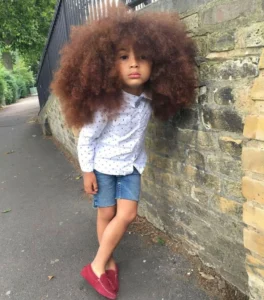
Every school enforces rules and regulations, often requiring students and parents to comply, even when these rules appear unnecessary or outdated. For 11-year-old Farouk James, these regulations have become a barrier to his education. Known on social media for his remarkable hair and unique look, Farouk has found himself at the center of a growing debate about fairness, culture, and personal identity in schools.
Farouk James is not just any child; he is already a recognized figure in the fashion world. With over 250,000 Instagram followers, his striking appearance and modeling work have brought him international attention. Yet despite his success, Farouk and his mother Bonnie are facing an unexpected struggle: finding a school in the UK that will accept him without forcing him to cut his hair. Many schools have strict hair-length policies, typically requiring boys to keep their hair short. Farouk’s natural, voluminous locks defy these rules, and administrators have repeatedly advised his family that he must trim them in order to attend.
For Bonnie, this demand feels deeply unfair. She argues that Farouk’s hair is completely natural — it is not dyed, chemically treated, or styled in any way that disrupts the classroom. To her, the issue isn’t about discipline or uniformity but about a rule that fails to reflect the diversity of modern society. She also points out the gender bias in such policies: if Farouk were a girl, no one would object to the length of his hair. This inconsistency, she insists, makes the enforcement of these rules discriminatory.
Farouk’s connection to his hair runs deep. His curls were visible even in prenatal scans, and his mother recalls doctors pointing them out before he was born. For him, his hair isn’t just about looks — it is part of who he is. The idea of cutting it to conform to school policy leaves him upset and conflicted. What many may see as “just hair” is, for Farouk, an important piece of his identity, tied to his confidence and sense of self.
Bonnie’s frustration is also shaped by past experience. Years ago, when her older son attended school, hair length was already a contentious issue. At the time, the school told her that her son’s hair was “too short.” Now, decades later, the same rigid thinking persists, only this time it is Farouk’s long locks being targeted. The fact that these appearance-based rules have not evolved in over twenty years has left Bonnie disheartened, but also determined to fight back.
Instead of quietly complying, Bonnie has turned her family’s struggle into a movement. She launched a viral campaign advocating for change, gathering support from parents across the UK and beyond. Many of these families have faced similar battles, particularly those with children who wear dreadlocks, Afro hairstyles, or other culturally significant looks. Together, they are uniting under the banner of the “Mane Generation,” a grassroots initiative pushing to challenge school rules that restrict hair length and natural styles.
“We’re getting a real team together and calling it the Mane Generation. We’re going to fight this until these rules get changed. And it’s globally, not just domestically in the UK,” Bonnie declared in a recent statement.
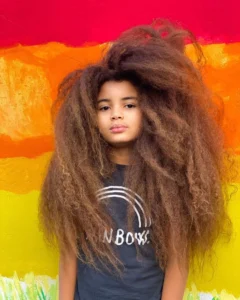
At the heart of the issue lies a larger question: should schools be allowed to dictate a child’s natural appearance in the name of uniformity? For critics of these policies, the answer is no. They argue that rules targeting natural hair disproportionately affect children from diverse backgrounds and send harmful messages about conformity over individuality. Supporters of reform believe education should empower children to be themselves, not suppress who they are.
Farouk’s story is more than a personal struggle; it is part of a wider cultural debate about freedom of expression, cultural identity, and fairness. His mother’s fight highlights how outdated rules can clash with modern values of inclusivity and respect. For many, long hair on men is not simply a style choice — it represents individuality, strength, and the rejection of restrictive norms.
As Farouk and Bonnie continue their campaign, they have become symbols of resilience and advocacy. Their journey reminds us that true education goes beyond textbooks and uniforms. It should teach acceptance, respect, and the importance of celebrating differences. In the end, the fight for Farouk’s hair is really a fight for every child’s right to express themselves freely, without being forced to sacrifice their identity in the name of conformity.